Mabel and Friends Book 6: Junebug and the Runaway Watermelon
Junebug Parker · Prairie Junction virtue series — Honesty
Manuscript proof — proof art below, pending approval · Story text complete · For Jeremy’s review
The refrain: “If I built it, I own it.”
🎨 Proof art — first look
The first two paintings for this book, made to the design lock. Both are proofs — nothing is final until Jeremy approves it.
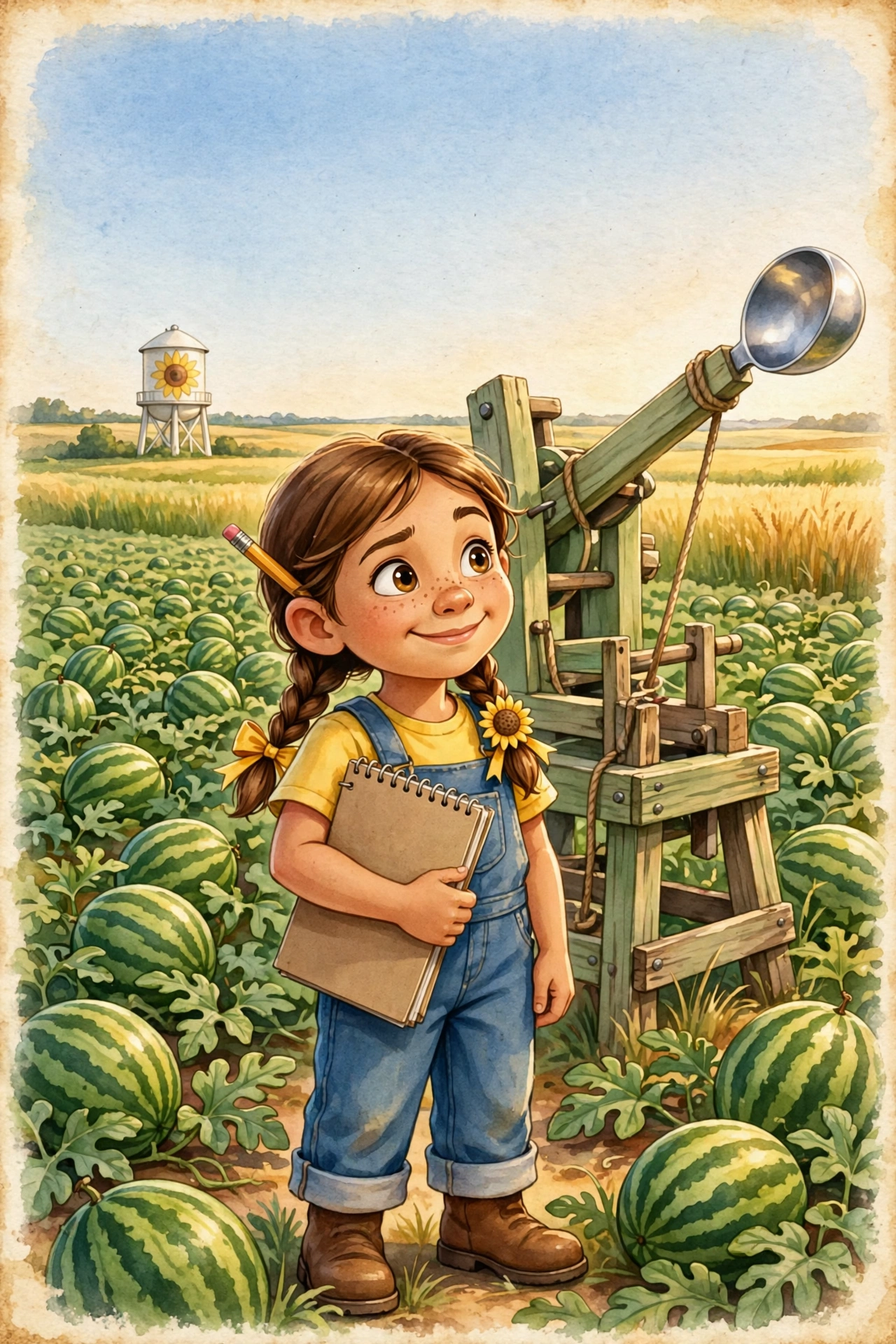
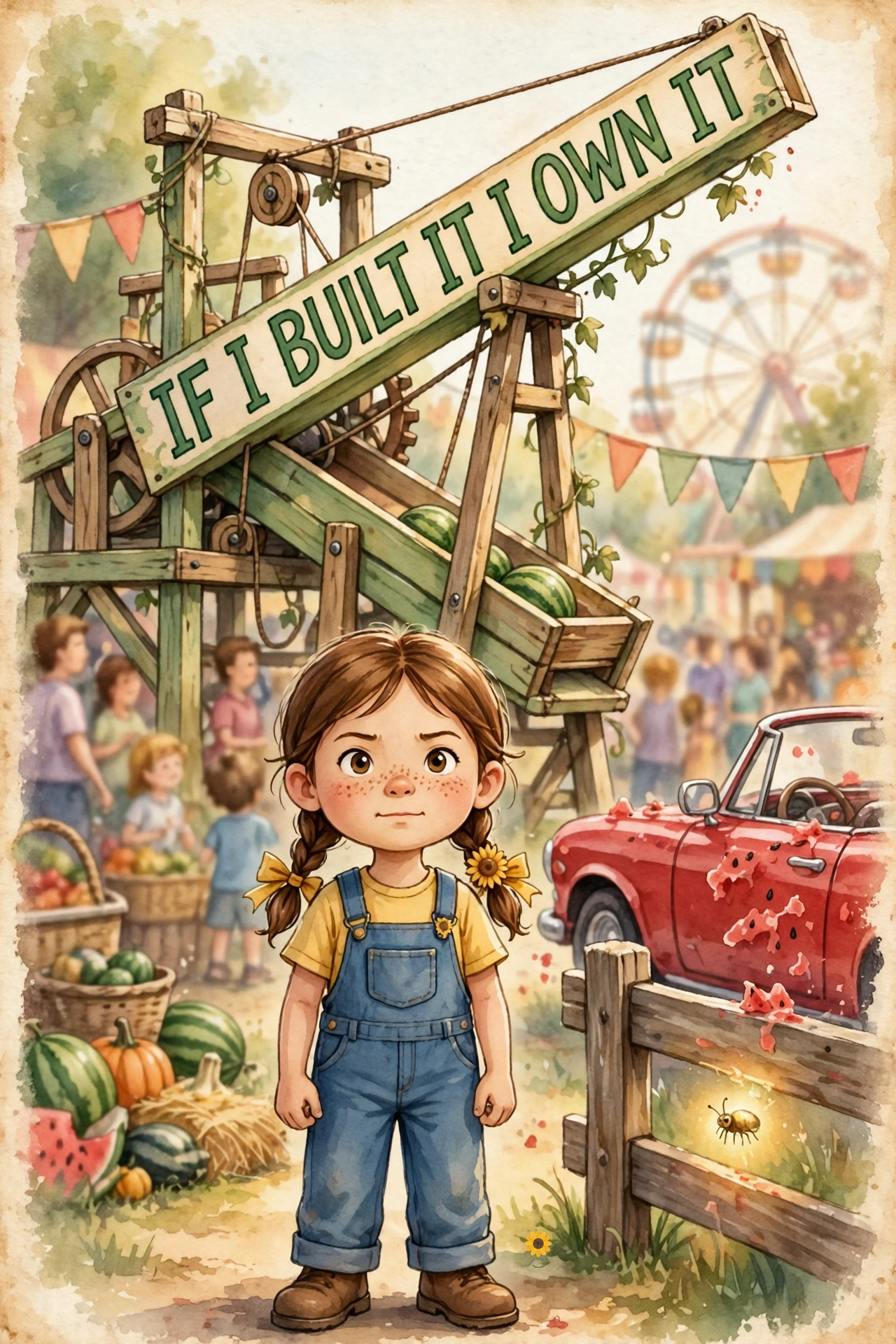
🔎 Hidden-object PROPOSAL (pending Jeremy’s ruling): Book 6 plays the game its own way — the manuscript’s rule: one tiny sunflower, hidden once, in Chapter 5 (the chapter where somebody tells the truth out loud). For this proof it stands in the grass by the fence in this scene. Junebug’s worn pin never counts.
1The Melon Problem
Junebug Parker could fix almost anything.
She had fixed the library doorbell. She had fixed Mr. Abernathy's squeaky wheelbarrow. Once, she had fixed the church bell with a hairpin, a spoon, and a ladder she was not supposed to climb — but that is another story.
What Junebug could NOT fix, on the last hot week of summer, was a math problem.
The problem looked like this:
The Parker family melon patch had grown 212 watermelons.
The Prairie Junction Harvest Festival was in six days.
And the festival stand was all the way across the fairgrounds, past the Meeting Tree, past the barns, past the Ferris wheel, at the far, far end of everywhere.
Two hundred and twelve watermelons. Six days. One long, dusty road.
Junebug wrote the problem in her lab notebook, in her best serious handwriting:
PROBLEM: TOO MANY MELONS. NOT ENOUGH LEGS.
"We'll haul them," said her dad, because hauling was what dads in melon families did, and he had the shoulders for it. "One cartload at a time. Like always."
Dad hauled a cartload on Monday. It took all morning.
Dad hauled a cartload on Tuesday. It took all morning AND he stepped in the creek.
On Wednesday, Dad hauled half a cartload, sat down in the shade of the Meeting Tree, and fanned himself with his hat.
"Two hundred and twelve," he said, in the voice of a dad doing terrible math. "At this rate, Junebug… the festival will be over. Christmas will be over. I will be a grandpa."
Junebug looked at the patch. She looked at the road. She looked at the long, long line between them.
Then she did what she always did when a problem was too big to push.
She opened her notebook to a fresh page, and she drew the problem instead.
On the fresh page, Junebug drew the patch. She drew the road. She drew the fairgrounds, and the stand, and the Ferris wheel, which she drew slightly too big because she liked it.
Then, in the sky above the road — in the big empty part of the page where nothing was — she drew a dotted line.
A dotted line that went UP, and OVER, and DOWN, in one beautiful curve.
With a watermelon on it.
"Dad," she said slowly. "What if the melons didn't go along the road?"
Dad blinked. "What if they went… over it?"
"Over it," said Junebug. "Through the air. Like the crow flies. Like a baseball. Like—"
"Like a watermelon should not fly," said Dad, "and yet here we are."
Junebug was already writing, fast, her pencil squeaking:
IDEA: A MACHINE THAT THROWS MELONS (GENTLY-ISH) FROM THE PATCH TO THE STAND.
Underneath, in smaller letters, she wrote the most important part of any invention:
NAME: THE MELON-LOADER 3000.
"Why 3000?" asked Dad.
"Because the Melon-Loader 1 sounds like it doesn't work yet," said Junebug. "And the Melon-Loader 2 sounds like it almost works. The 3000 sounds like it has already thrown a thousand melons and is bored."
"Has it thrown any melons?" asked Dad.
"Not yet," said Junebug, and she grinned the grin that made everybody who knew her a little bit nervous and a little bit excited at the same time. "That's tomorrow's problem."
2Building the Melon-Loader 3000
Every inventor needs a co-builder, and Junebug's co-builder was her dad, who could hold anything in the world perfectly steady, and who asked exactly the right questions.
Dad studied her drawing for a long time.
"It's a catapult," he said.
"It's a Melon-Loader 3000," said Junebug.
"It's a catapult with good manners," said Dad. "I love it. Where do we start?"
They started at Mr. Abernathy's hardware store on Junction Street, with a list as long as Junebug's arm:
Two strong boards. One wagon wheel. Rope — the good kind. A bedspring. Bolts. Hinges. One bucket of paint, melon green.
And at the bottom of the list, in Junebug's writing:
One very big spoon.
Because every catapult has an arm, and at the end of the arm there is a cup that holds the thing being thrown, and Junebug had measured, and the very best watermelon-shaped cup in all of Prairie Junction was the soup ladle from Dottie's Diner.
Dottie lent it to her. "Bring it back washed," Dottie said, "and tell me everything."
They built it at the edge of the melon patch, where the ground was flat and the view was fine.
Dad hauled the lumber. Dad climbed and held. Junebug measured everything twice — once with the tape measure, and once with a piece of string, because, as she wrote in the notebook:
A GOOD INVENTOR MEASURES TWICE. A GREAT INVENTOR MEASURES TWICE AND THEN ASKS THE STRING.
The machine grew.
A frame, strong as a barn door. A long arm, longer than Dad. The wagon wheel at the side, to winch the arm down, click by click by click. The bedspring underneath, for bounce. And at the top of the arm, bolted tight, the great spoon, shining in the sun.
Last of all, Junebug got out the melon-green paint.
She painted the whole machine green. Then, on the long arm, in her tallest, proudest letters, she painted the words she had written on the inside cover of her very first lab notebook, back when she was five and the notebook was bigger than she was:
IF I BUILT IT, I OWN IT.
"What's that mean?" asked Dad, from the ladder.
"It means if the machine works, I get to say 'I built that,'" said Junebug. "And if the machine breaks something… I have to say 'I built that' then, too. Same words. Both times."
Dad thought about that. "Even the second kind?"
"Especially the second kind," said Junebug. "Anybody can own the good throws."
She was just a little bit proud of how grown-up that sounded.
That evening, when the paint was dry and the sun was going down behind the water tower, Dad turned the wagon wheel and winched the arm down, slow and creaky:
Click. Click. Click. CLICK.
The bedspring stretched. The rope hummed like a plucked string.
The Melon-Loader 3000 was loaded, cocked, and ready.
There was only one thing left to do.
"Tomorrow," said Junebug, and she wrote it in the notebook in letters so big they took up the whole page:
TEST DAY.
3Test Day (and Test Night)
Test Day started the way all important days should start: with a test pilot.
Mabel the field mouse arrived wearing a helmet.
The helmet had a chin strap. The helmet had a stripe. The helmet was nearly as big as Mabel was, and in Mabel's opinion, it made her look extremely professional.
"Reporting for duty," squeaked Mabel. "What am I riding?"
"You get exactly one ride," said Junebug, who had thought about this very carefully. "The light test. Lowest notch. Arm barely lifts. You sit in the spoon, you hold on to the melon, and the machine tips you — gently — into that pile of hay bales. After that, you are my spotter. The machine throws things, Mabel. Things, not mice."
"And the helmet?" asked Mabel.
"The helmet," said Junebug, "is because I have met my melons."
Test Launch Number Zero was the light test.
Mabel climbed into the great spoon and hugged the melon, her tail curled tight, and Dad winched the arm to the lowest notch there was, and Junebug stood well back —
— and the arm rose up slow and stately, like a spoon in a giant's teacup, and tipped Mabel and the melon together into the hay with a soft, rustling whumpf.
Two ears and a thumbs-up rose out of the hay.
"Spotter report!" squeaked Mabel, from inside the haystack. "The pilot is fine! The melon is fine! The hay is DELICIOUS-smelling!"
"And that's the last ride," said Junebug, writing it down. "The spoon is for melons now. Mabel, you're on spotting."
Mabel saluted from the hay. "Professional," she said.
Test Launch Number One.
Junebug set a melon in the great spoon. Dad winched the arm down, and stood well back, holding the rope that would let the arm fly.
"On three!" called Junebug. "One! Two! THREE!"
Dad let go.
SPROING—THWACK—FWOOM!
The arm swung up like it was waving at the moon. The melon soared into the blue — up, up, up — a perfect green moon rising in the morning —
— and landed in the creek.
SPLOOSH.
There was a silence. Then, from the creek, the melon bobbed gently past, floating downstream like a very surprised boat.
"Spotter report!" squeaked Mabel from behind the safety line. "The melon has gone swimming!"
Junebug wrote it down, because a Parker writes it down:
TEST 1: TOO FAR LEFT. MELON IN CREEK. NOTE: MELONS FLOAT. GOOD TO KNOW.
Test Launch Number Two.
Dad adjusted the arm two notches. Junebug turned the whole machine a thumb's width to the right. They loaded a smaller melon and let it fly.
Up it went! Beautiful! Straight! True!
It landed on the roof of the Parker tool shed and rolled, with great dignity, roll… roll… roll… down the slope and into Grandma Armadillo's rain barrel.
KER-SPLOOSH.
"Spotter report!" squeaked Mabel. "The melon has gone swimming AGAIN, but fancier!"
TEST 2: TOO HIGH. ROOF, THEN BARREL. NOTE: AIM LOWER. ALSO, GRANDMA'S BARREL IS EXACTLY THE WRONG PLACE.
Test Launch Number Three went straight up and straight down, and Junebug and Dad and Mabel and Biscuit all ran in four different directions, and the melon landed with a tremendous THUD in the soft dirt precisely where Junebug had been standing.
Nobody wrote anything down for a whole minute. Then Junebug wrote:
TEST 3: NO. JUST NO. START OVER.
All afternoon they tuned. A notch up. A notch down. A shorter rope. A longer string on the measuring. Dad hauled the machine six inches to the left, then three inches back, because tuning a catapult is mostly moving it three inches at a time while saying "hmm" like you mean it.
And after every single test — every splash, every thud, every roll — there were melon rinds to clean up, and that job belonged to Biscuit, the Parkers' pig, and his cleanup crew, which was Biscuit, and also Biscuit, because pigs love melon rinds the way some people love birthday cake.
"You can keep testing forever, Junebug," said Biscuit happily, munching. "Best. Job. Ever."
By suppertime they had it almost right. The melons were landing near the hay-bale target — near-ish, in the target's neighborhood, close enough to wave at the target.
"One more test," said Dad, wiping his forehead. "Tonight. After dark. The air is cooler and the spring sits better."
"After dark?" said Junebug. "We won't be able to see where it lands."
"Then the target gets a light of its own," said Junebug — because she was already solving it, the way she solved everything. She hung the big barn lantern on the hay bales, right on the bullseye, and lit it.
It glowed gold in the dusk, a small bright star sitting at the end of the long field.
So Test Launch Number Seven — the lucky one, Junebug had decided, because six tests had not been lucky — happened by lantern light.
"On three!" Junebug called, quiet, because night tests feel like they should be quiet. "One… two… three."
SPROING—THWACK—FWOOM.
The melon rose into the dark, a black shape crossing the moon — down it came — down — down —
— and landed plop in the soft hay at the very edge of the target, close enough that the lantern light shone right through the leaves of it.
"BULLSEYE!" shouted everyone, and then everyone shushed everyone else, because it was night, and then everyone cheered anyway, but in whispers, which is somehow louder.
Junebug wrote it down by lantern light, her pencil slow and happy:
TEST 7: IT WORKS. IT REALLY, REALLY WORKS.
SEE YOU AT THE FESTIVAL, MELONS. YOU ARE GOING TO FLY.
4Grandma's Porch
The day before the festival, Junebug did the thing she did before every big day.
She went to Grandma Armadillo's porch, with her notebook, for lemonade and thinking.
Grandma's porch had the best thinking in Prairie Junction. This was a scientific fact, probably. Junebug had never tested it. Some things you just know.
Grandma brought out two glasses of lemonade and settled into her rocker, and for a while they just sat, and the ice went tink, tink in the glasses, and the patch below them was green and gold and heavy with melons.
"Two hundred and twelve," said Grandma. "And a machine to move them."
"Two hundred and six now," said Junebug. "The creek has one. The barrel has one. Tests Three through Six have… gone to be with Biscuit."
Grandma nodded like this was all perfectly normal, which, on the Parker side of the family, it was.
"Read me the page," said Grandma.
So Junebug read her the notebook, the way she always did — the problem, the idea, the seven tests, the splashes and the thud and the one beautiful night throw.
Grandma listened with her eyes closed and her rocker going slow, creak… creak… and when Junebug finished, Grandma pointed one claw at the inside cover of the notebook.
"Read me that part."
Junebug turned to the inside cover. Her own five-year-old handwriting wobbled up at her, big and earnest:
IF I BUILT IT, I OWN IT.
"You remember where that came from?" asked Grandma.
"You," said Junebug. "Sort of. Tell it again?"
Grandma smiled into her lemonade.
"When you were five, you built a ramp for your toy trucks out of my good cookbooks," she said. "And the ramp worked beautifully, right up until a truck took the corner too fast and knocked my blue pitcher clean off the porch rail."
"I remember the pitcher," said Junebug quietly.
"You came to me holding the handle," said Grandma. "Nobody saw it happen, Junebug. Nobody would ever have known. And you stood right there in your overalls and you said, 'Grandma, my ramp did it. I built the ramp.'"
The rocker went creak… creak…
"And I said what I said." Grandma reached over and tapped the notebook cover, once, with one claw. "A Parker writes it down and owns it. The good throws and the bad ones. That's the whole rule. It isn't two rules."
"I know," said Junebug. "I painted it on the machine."
"I saw," said Grandma. "Half the county saw. Your letters are six inches tall."
Junebug grinned. Then the grin faded a little, and she turned her lemonade glass in a slow circle.
"Grandma. What if it goes wrong tomorrow? In front of everybody?"
"Then it goes wrong in front of everybody," said Grandma, "and everybody watches what you do next. That's the part they remember, June. Not the throw. The next part."
Junebug thought about that for a while. The ice went tink, tink.
"Tell it true," she said, half to herself.
"What's that?" said Grandma.
"Nothing. Just… something I say in my head, when the real thing is hard to say out loud. Tell it true. It helps me start."
"Mm," said Grandma. "Put it in the notebook."
So Junebug opened the notebook and wrote it on the inside cover, under the rule, in smaller letters, where it has stayed ever since:
IF I BUILT IT, I OWN IT.
Tell it true.
Early the next morning — so early the fairgrounds flags were still asleep — Junebug and her dad rolled the Melon-Loader 3000 onto the flat ground at the edge of the patch, aimed down the great open field toward the festival stand, where Mr. Abernathy waited with the catching nets and a pile of hay bales.
Dad did the final setup with her, the way they'd done every setup all week, quick and careful: check the bolts, check the rope, winch the arm down — click, click, click — and set the last notch on the lever with his own hand.
"She's ready," said Dad. "She's perfect."
The sun came up gold over the water tower.
It was festival day.
5Festival Day
The Harvest Festival was the best day of the year in Prairie Junction, and that is not Junebug's opinion. That is just the day being itself.
There were fiddles. There were pies. There was a Ferris wheel turning slow against a blue sky, and flags snapping, and the smell of kettle corn rolling over everything like a delicious fog.
And at the far end of the fairgrounds stood the Parker melon stand, with Junebug's hand-painted sign:
PARKER MELONS — SWEET AS SUMMER!
There was only one problem, and by now you know what it was: the melons were all still at the other end of the fairgrounds, in the patch, two hundred and six of them, round and heavy and going nowhere.
At eleven o'clock, a crowd had gathered.
At eleven o'clock, Mayor Goodwin himself strolled down to the patch end of the field to see what all the fuss was about. Mayor Goodwin wore his festival hat and his festival smile, and he had parked his shiny red convertible — his pride and joy, polished like a giant cherry — just past the fairground fence, in the shade, where cars were not supposed to park on festival day.
Nobody noticed the car. It was behind the hay bales. It was behind the banner.
It was, although nobody knew it yet, in exactly the wrong place.
Junebug checked the machine one last time. Bolts: tight. Rope: strong. Spoon: shining. Letters on the arm, six inches tall, for the whole county to read:
IF I BUILT IT, I OWN IT.
"First melon of the festival!" she announced, and the crowd cheered, and Dad loaded a big beautiful melon into the great spoon and stood at the wheel, and Mabel stood behind the safety line in her helmet being professional.
"On three!" called Junebug. "One! Two! THREE!"
Junebug pulled the lever.
SPROING — THWACK — FWOOOOOM!
Oh, it was perfect.
It was the best throw the Melon-Loader 3000 had ever thrown — better than Test Seven, better than the drawing, better than the dream Junebug had had about it on Tuesday.
The melon rose into the festival sky in one long, beautiful, postcard arc — over the field, over the hay bales, over the banner —
— and kept going.
Over the fence.
Over the shade.
Down.
Down.
Down.
Right into the back seat of Mayor Goodwin's shiny red convertible.
SPLOOOOSH—CRUNCH.
There was a sound like a whole fruit salad sitting down hard.
And then there was a silence — a festival silence — two hundred people all not saying anything at exactly the same time.
The convertible wore the watermelon now. It wore it in the front seat. It wore it in the back seat. A slice of it, neat as a smile, sat on the steering wheel.
High above the field, the crowd's cheer was still finishing, late, like an echo that hadn't gotten the news.
Junebug had about four seconds.
Four seconds is not very long. It is one-one-thousand, two-one-thousand, three-one-thousand, four. It is long enough to think four or five whole thoughts, if your thoughts run fast.
Junebug's thoughts ran very fast.
Nobody's looking at me yet, thought Junebug. They're all looking at the car.
From the crowd, somebody called out — helpful, hopeful, handing her an excuse like a life ring:
"Wasn't that the wind? I felt a gust! Didn't everybody feel a gust?"
The wind, thought Junebug. People would believe the wind. The wind can't get in trouble.
Her own thoughts ran faster:
Nobody actually SAW it leave the machine. It happened so fast. Nobody can prove it. I could just… not say anything. I could just be a girl standing near a machine.
And then her dad was there.
Dad's face was doing something terrible. He pulled her half a step aside, quick, and talked fast and low, the way you talk when you're offering somebody your own umbrella in a storm:
"Junebug. Listen. I set the last notch on the lever this morning. My hand was the last one on it. If anybody asks, it was my setup. It was my throw. You just say that. I'll take it."
It would be so easy. It would be so, so easy. Dad was OFFERING. It wouldn't even be her idea. She'd just have to… let it happen. Stand there. Say nothing. Let the four seconds run out.
That was the worst thought of all, and it was hers:
I could just say nothing at all.
In the crowd, somebody laughed nervously. Somebody else said, "Whose machine is that?" The four seconds were almost gone.
And in the front of the crowd stood Grandma Armadillo.
Grandma didn't wave. Grandma didn't call out. She just stood there in the bright festival morning with her lemonade in her hand, looking at Junebug the way she had on the porch — not worried, not scolding. Just certain. The look that said: I know whose rule that is.
Not at her like a judge. With her. Like somebody standing next to you in the hard part.
Tell it true, thought Junebug.
Her hand was shaking. Her voice, when it came, was not big at first. But it was hers.
"It was mine," said Junebug.
Two hundred people turned around.
"The machine is mine," said Junebug, louder, stepping forward — in front of the machine, not behind it. "I built it. I aimed it. I called the throw. The melon that landed in the Mayor's car — that's my melon, from my machine, and I'm sorry, and I'll make it right."
"If I built it," she said, and her voice only shook a little, "I own it. That's the rule. It's painted on the side."
And it was. Six inches tall. The whole county could read it.
The silence changed. Silences can do that. This one wasn't shocked anymore. This one was something else — something warmer, and listening.
Mayor Goodwin walked slowly down the field toward her, watermelon juice on one festival shoe, looking at his car, looking at the machine, looking at the small inventor standing in front of it with her chin up and her hands shaking.
He stopped in front of Junebug.
The whole festival held its breath.
6Making It Right
"Well," said Mayor Goodwin at last. He looked at his car. He looked at Junebug. A smile started at the corner of his mouth and had to push past a lot of surprise to get there.
"Parked it behind the hay bales, didn't I," he said. "Right where the festival signs SAY not to park. Hm." He rubbed a rind off his shoe. "That doesn't excuse the melon, young lady. But it does explain the parking."
"I'm still sorry," said Junebug. "And I'll still make it right."
"Will you," said the Mayor. "All right. Show me."
So Junebug made it right. That is not a figure of speech. It is a list, and she wrote it in the notebook before she did a single part of it, because a Parker writes it down:
MAKE-IT-RIGHT LIST: 1. Clean the car. Every bit of it. 2. Pay for the car wash polish and the seat cleaning out of my festival money. 3. Free melons for the Mayor's whole table. 4. Fix the aim. Move the machine. Never throw over the fence again. EVER.
Item One took the whole town about four minutes to start, because the moment Junebug picked up a bucket, Dottie picked up a sponge, and the moment Dottie picked up a sponge, Mr. Abernathy picked up the hose, and the moment Mr. Abernathy picked up the hose, her dad climbed INTO the back seat with a scrub brush and an expression of deep personal responsibility, and said, "I set the last notch. I scrub the seats. That part's mine, and I mean it."
Junebug let him. Some help is somebody dodging for you — and some help is somebody standing next to you. She had learned the difference about four seconds ago.
Mabel held the barn lantern into the dark corners inside the car so nobody missed a seed. Biscuit ran the rind-cleanup crew, which was still just Biscuit, at his happiest, eating the evidence one rind at a time. ("Best. Day. Ever," said Biscuit, to no one in particular, from inside a melon smile.)
The whole festival washed that car. Folks in festival hats. Folks holding babies. The fiddle band, between tunes. It stopped being a chore around minute three and turned into the best party of the day, the way things in Prairie Junction sometimes do when everybody grabs a sponge.
Item Two cost Junebug every penny of her festival money — the polish, the seat-cleaning powder, the special cloth for shiny red paint, all of it, counted out of her melon earnings envelope coin by coin on Dottie's counter.
It stung a little. It was supposed to. That's how she knew it was the real price and she was really paying it.
Item Three was easy and delicious.
Item Four took the rest of the afternoon: the Melon-Loader came apart at the bolts and went back together twenty feet to the left, aimed down the wide mowed lane to the stand — with hay bales on BOTH sides, a catching net like a baseball glove the size of a barn, and a brand-new rule painted on a sign and nailed to the fence:
MELON LANE. NO PARKING. NO, REALLY. — J.P.
And then — with the Mayor's permission, and the Mayor holding the flag — the Melon-Loader 3000 threw again.
SPROING — THWACK — FWOOOOOM!
Up. Over. Down the lane. Into the net, soft as a ball into a mitt.
The crowd lost its mind. Hats went up. The fiddles went wild. Melon after melon flew down the lane all afternoon — fwoom, fwoom, fwoom — until all two hundred and five remaining melons stood stacked at the Parker stand, sweet as summer, and Dad lay in the shade of the Meeting Tree fanning himself with his hat and said this was the finest hauling job he'd ever not done.
When the car was finished — washed, polished, seats scrubbed, cloth-buffed, shining — Mayor Goodwin walked around it twice, inspecting, the way mayors inspect things, seriously and with ceremony.
Then he announced, to Junebug, simply:
"It's cleaner than before."
And it was. It truly was. The red shone deeper. The chrome winked. It was the cleanest car in the county, and half the county had washed it, and somehow that was the truest sentence of the whole day.
Mayor Goodwin stood looking at it a long moment. Then he turned to Junebug.
"Next year," he said, "the town is buying new nets, new bales — and commissioning a proper melon loader for the fairgrounds. Permanent. Built right. With a parking plan." He stuck out his hand. "I'd like the inventor of the machine to build it. If she's willing."
Junebug shook his hand with her whole arm. "She's willing," she said. "She has NOTES."
That night, after the fireworks, after the last dance, after the Ferris wheel went dark, Junebug sat under the Meeting Tree with her notebook and her family around her in the grass, and she wrote the last page of the melon problem.
Her dad read it over her shoulder. "Are you putting ALL of it in? The car and everything?"
"All of it," said Junebug. "The good throws and the bad ones. That's the whole rule. It isn't two rules."
She wrote:
FESTIVAL DAY: THE MACHINE WORKED PERFECTLY. THAT WAS THE PROBLEM.
ONE MELON, ONE CAR, ONE MESS.
TOLD IT TRUE. PAID THE PRICE. WASHED THE CAR (EVERYBODY HELPED).
RESULT: CLEANER THAN BEFORE.
NEXT YEAR: SAME MACHINE, BETTER AIM, AND A PARKING PLAN.
She closed the notebook. Grandma held the lantern steady over the page, one small warm light, like a period at the end of a sentence.
"Junebug?" said Mabel, from the grass, half asleep in her helmet. "Best festival ever?"
Junebug looked at the dark fairgrounds, and her empty money envelope, and her family.
"Best festival ever," she said. "Up again. Dust off. Fly again."
And in the morning — well. In the morning there would be a new page, and a new problem, and probably a ladder she was not supposed to climb.
But that is another story.
Back matter (printed at the end of the book)
The Melon-Loader 3000 — Junebug's blueprint page: A full-page dashed-line blueprint in Junebug's notebook style: frame, long arm, wagon-wheel winch, bedspring, rope, and the great borrowed spoon, each part labeled in her handwriting, with her own notes in the margins — "MEASURE TWICE. ASK THE STRING." / "NOBODY RIDES THE SPOON." / "AIM DOWN THE LANE." plus a dotted arc ending in a net (not a car). Footer, in her writing: "If I built it, I own it. — J.P."
Simple machines in this book (one short note): "Junebug's catapult is really three simple machines working together: a lever (the long arm that swings), a wheel and axle (the wagon wheel that winches it down), and springs and ropes storing energy until — FWOOM. Real inventors have used the same three ideas for thousands of years. None of them ever aimed at a convertible. Probably."
Find the sunflowers! "Somewhere in this book's pictures, SIX tiny sunflowers are hiding — one in every chapter. Can you find all six? (Junebug's pin doesn't count — there's always one more, and hers is right there on her braid where everybody can see it.)"
For grown-ups (one line, optional): "Junebug's story is about honesty — owning what you built, the good throws and the bad ones, out loud and before anyone asks." (Series virtue line; kept to back matter so the story itself never lectures — the word appears here, and nowhere in the chapters.)